
You are standing in a room with a wall of stereo equipment: a turntable with a heavy platter, a silver-faced receiver, a reel-to-reel deck with its reels still threaded, speakers the size of small refrigerators. Maybe this was your father's system. Maybe it was yours, decades ago. Either way, you need to know: is any of this worth real money, or is it just heavy?
The short answer is that certain vintage audio gear sells very well at auction, sometimes surprisingly well. But the category is specific. What matters is the brand, the format, the condition, and how you handle the equipment between now and the sale. Here is what you need to know.
Which categories hold value
Not all vintage audio is equal. The market draws a hard line between component separates and all-in-one consoles. A console stereo from the 1960s or 1970s, the kind built into a wooden credenza with a turntable under a lid, is almost always worth more as furniture than as audio equipment. Some mid-century consoles do sell, but for their design, not their sound. Separates are where the real demand lives.
Turntables, tonearms, and cartridges
A quality turntable is often the single most valuable piece in a home stereo system. Direct-drive decks from Technics, belt-drive tables from Thorens or Linn, and high-end Japanese models from Micro Seiki or Denon all attract serious bidders. The tonearm matters independently. So does the cartridge, the small stylus assembly mounted at the end of the arm. A moving-coil cartridge from a respected maker can be worth more than the turntable it is attached to. Do not remove or discard cartridges.
Tube amplifiers and preamps
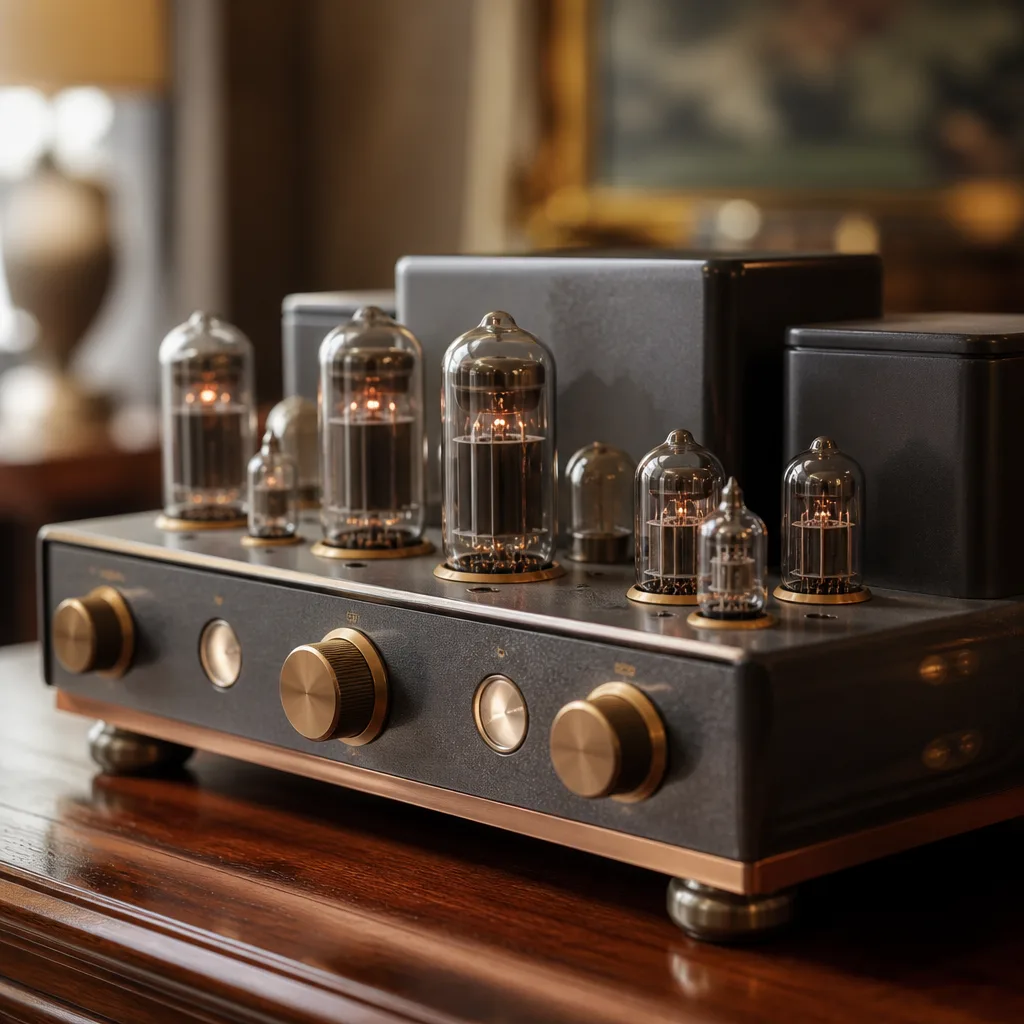
Vacuum tube gear occupies a special place in the market. McIntosh tube amplifiers and preamps are consistently among the most sought-after pieces in any audio auction. Marantz tube receivers from the late 1950s and 1960s generate intense competition. Fisher, Scott, and Dynaco also have loyal followings. Tube equipment is valued for its sound characteristics, but also because it is repairable. A skilled technician can restore a tube amp to full performance in ways that are harder with solid-state boards.
Receivers from the 1970s
The silver-faced receivers that powered most American living rooms in the 1970s are a broad category with wide value ranges. At the top: flagship models from Pioneer, Sansui, Marantz, and Kenwood, particularly high-wattage units with wood cases. Mid-tier receivers can still bring respectable results if they are clean, functional, and complete. Entry-level models are harder to sell individually but can add value when offered as part of a matched system.
Reel-to-reel and cassette decks
Reel-to-reel tape decks from brands like Revox, Studer, Ampex, Otari, and Technics draw both audiophiles and recording professionals. Nakamichi cassette decks, particularly the Dragon and the higher-numbered models, remain desirable because of their engineering reputation. Other cassette decks generally need to be from a top-tier maker to attract auction interest.
Speakers and studio monitors
Vintage speakers can be extremely valuable or nearly unsellable, and the difference comes down to the maker and model. JBL studio monitors, Altec Lansing Voice of the Theatre components, Klipsch horn-loaded designs, Tannoy dual-concentrics, and Quad electrostatics all have dedicated buyer communities. Matched pairs are essential. A single orphan speaker is worth a fraction of a pair.
The names that consistently draw bidders
Certain brands reliably generate competition at auction: McIntosh, Marantz, Nakamichi, Pioneer (flagship models), Sansui, Technics, Thorens, Klipsch, JBL, Altec Lansing, Tannoy, Quad, Luxman, and Accuphase. Japanese brands from the 1970s and early 1980s are particularly strong right now. If you see any of these names on the faceplate or rear panel, take that piece seriously.
Less familiar names can also hold value. Smaller manufacturers like Audio Research, Conrad-Johnson, Mark Levinson, or Krell made high-end gear in limited quantities. If something looks expensive and you do not recognize the brand, do not assume it is worthless. Get it evaluated.
What moves the price up
Condition and originality. Collectors want equipment that is as close to factory-original as possible. Unmodified circuits, original capacitors (if still functional), matching serial numbers on paired components, intact cosmetics. A receiver with its original walnut case and no scratches on the faceplate is worth meaningfully more than one with a dented front panel.
Working order. Equipment that powers on, produces clean sound, and has all functions operating will always outperform non-working pieces. That said, even non-functional gear from a top maker can sell. Buyers who restore audio professionally are active at auction.
Documentation and packaging. Original boxes, packing materials, owner's manuals, warranty cards, and purchase receipts all add value. Keep them. If you find a remote control in a drawer, reunite it with the component.
Matched pairs and complete systems. A single-owner system where the turntable, preamp, amplifier, and speakers were bought together and used together often does better presented as a collection than broken into individual lots. It tells a story of care and intention. Buyers respond to that. An auction house can advise whether the pieces are better sold together or separately based on the specific equipment involved.
What destroys value
Some damage is obvious: cracked faceplates, missing knobs, torn speaker grilles. Other problems are less visible but just as costly.
- Bad recapping. Replacing capacitors is sometimes necessary, but a sloppy recap job done with mismatched parts or poor soldering can reduce value below that of an untouched original. Buyers would rather do the work themselves.
- Replaced speaker drivers. If someone swapped in non-original woofers or tweeters, the speaker loses much of its collector appeal.
- Poor refoaming. Speaker surrounds deteriorate with age, and refoaming is common. But a bad refoam, with visible glue or the wrong material, hurts more than it helps.
- Missing dust covers. The acrylic or smoked-glass dust cover on a turntable matters more than you might expect. Replacements are hard to find and expensive.
- Rodent damage and long garage storage. Mice chew wiring, nest in speaker cabinets, and corrode contacts. Equipment stored in a damp garage or shed for years may look fine outside but have serious internal problems. Mold, corrosion, and insect damage are common.
How to handle the equipment before a sale
The most important piece of advice: do not plug in and power up equipment that has been sitting unused for years. Old capacitors can fail catastrophically when energized after long dormancy, potentially damaging other components or creating a safety hazard. If you want to test it, have a qualified audio technician do it with a variac, a device that brings voltage up gradually.
Beyond that, a few practical guidelines:
- Do not aggressively clean or polish faceplates. A soft dry cloth is fine. Chemical cleaners, metal polish, and abrasive pads can strip original lettering or damage anodized finishes permanently.
- Keep everything together. Remotes, manuals, original cartons, even the packing foam.
- Photograph the rear panel, the model plate, and the serial number plate on every component. These photos help an auction house identify exactly what you have.
- If speakers have grilles, leave them on. Removing grilles exposes drivers to damage during handling.
- Do not disassemble anything. Leave tubes in tube amps, cartridges on turntables, and reels on decks.
Why vintage audio does better at auction than at a garage sale
Vintage audio buyers are specialists. They know the models, they know the production years, they know what a particular capacitor revision means for sound quality. Those buyers are not driving through Altadena on a Saturday morning looking at card tables. They are searching online, worldwide.
This is exactly where an established auction house adds value. Hughes Estate Sales & Auctions, founded in 1978 by Larry Hughes in Pasadena, markets auction lots to an email list of 13,000+ subscribers and provides worldwide marketing exposure. For a category like vintage audio, where a buyer in Tokyo or Berlin may pay more than anyone in Southern California, that reach matters. Results in other specialist categories illustrate the point: a Fern Coppedge painting brought $120,000 and a Rolex Daytona sold for $60,000 in documented past sales. Those are specific results in different categories, but they show what happens when the right item reaches the right audience.
An auction house evaluation typically starts with a walkthrough or a photo review. The team identifies the makers and models, assesses condition, and recommends whether pieces should be sold individually, in groups, or as a complete system. Professional appraisals are a different product from an auction estimate, particularly if you need a formal valuation for legal or tax purposes, but a free consultation gives you a clear starting picture.
Frequently asked questions
Is my old stereo receiver worth anything?
It depends entirely on the brand, model, and condition. Flagship receivers from Pioneer, Sansui, Marantz, and similar makers hold strong value. Entry-level or department-store brands generally do not, unless they are part of a larger collection. A free estimate from an auction house will give you a realistic answer.
Should I have the equipment repaired before selling?
Usually, no. Buyers in this market often prefer to do restoration themselves or use their own trusted technicians. A well-intentioned but poorly executed repair can reduce value. Present the equipment as-is and disclose what you know about its condition.
How long does the auction process take?
At Hughes, auctions are typically scheduled one to twelve months out, depending on the type of sale and the items involved. Payment to consignors is issued within 35 business days after the sale. If you need faster results, estate buyouts can close in as little as one day and typically within a week.
What if I have a whole room full of equipment?
That can actually work in your favor. A single-owner collection with matched components and documented provenance often generates more interest than scattered individual pieces. An auction house can evaluate the collection as a whole and recommend the best approach.
Can I just sell it on an online marketplace myself?
You can, but vintage audio is heavy, fragile, and expensive to ship. It also attracts scams and lowball offers. An auction house handles photography, descriptions, buyer vetting, payment, and shipping logistics. For high-value gear, the difference in final price typically more than covers the cost of professional handling.
Get a clear answer on what you have
If you are clearing a home in Pasadena, San Marino, Beverly Hills, or anywhere across Greater Los Angeles and you have come across a stereo system that looks like it was someone's pride, take the time to find out what it is worth before giving it away or leaving it for the cleanout crew. Hughes has handled estates across Southern California since 1978 and has genuine expertise in vintage audio alongside categories like fine art, jewelry, and collector vehicles. Consultations and estimates are free. Ask about consignment, call (626) 791-9600, or email info@hughesauctions.com.
